



Post Date : Monday, August 11, 2025
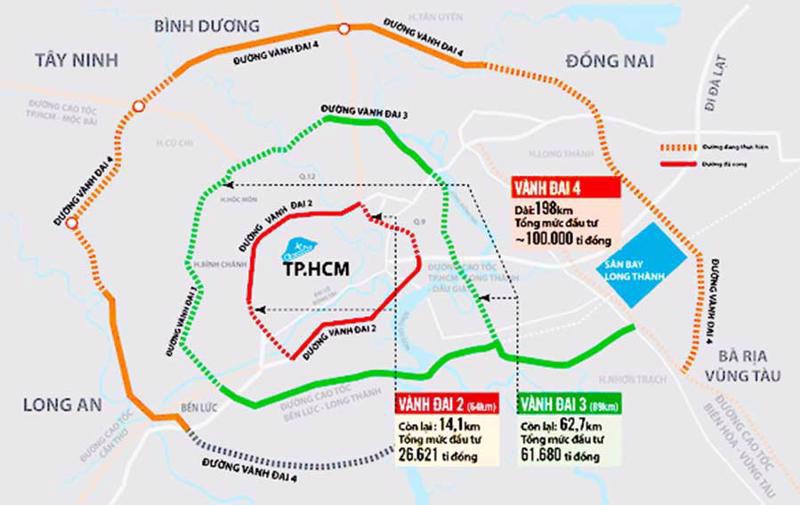
The Ho Chi Minh City Ring Road 4 spans more than 207 kilometers, with a total investment exceeding VND 120 trillion (approximately USD 4.73 billion). It runs through five provinces and cities: Ho Chi Minh City (16.7 km), Binh Duong (47.95 km), Dong Nai (46 km), Ba Ria – Vung Tau (18.2 km), and Long An (78.3 km).
This inter-regional transport artery will effectively connect radial expressways with surrounding satellite cities.
Tay Ninh Province (formerly Long An) has the longest section on the route—about 78.3 km, accounting for nearly 40% of the total length. The route passes through 15 key communes, including Hau Nghia, Duc Lap, Ben Luc, Long Cang, Can Giuoc, and others, linking directly to Ho Chi Minh City via Provincial Road 830, making it a critical logistics corridor in the West.
Currently, the Binh Duong section broke ground on June 18, while the Long An (old) and Dong Nai sections are scheduled to start in 2026 and complete by 2028. Once operational, Ring Road 4 will shorten travel time between Long An (old) and Ho Chi Minh City by 30–40%, to just 15–30 minutes.

Ring Road 4 is not only expected to ease urban traffic pressure but also serve as a powerful catalyst for the western real estate market. Areas along the route are seeing strong capital inflows and new developments.
Ben Luc: Home to major industrial parks such as Phuc Long, Thuan Dao, Vinh Loc 2, Phu An Thanh, and Prodezi, as well as large-scale residential areas. Land prices along major connecting roads have started to rise, particularly in commercial land and townhouse segments.
Duc Hoa – Can Giuoc: Bordering southern Ho Chi Minh City, benefiting from quick access to the South and Hiep Phuoc Industrial Park, attracting developers and investors alike.
Long Cang – Rach Kien – My Le: Large land reserves with strong potential for planned satellite cities.
Ring Road 4 is a new strategic infrastructure route that positions Long An (formerly) as a focal point, as it holds the longest section of the entire route.Leading real estate corporations are aggressively positioning themselves:
Vingroup: The nearly 200-hectare Vinhomes Green City in Duc Hoa recorded 2,000 bookings within 24 hours of launch. On August 19, the group will also break ground on the Phuoc Vinh Tay Urban Area in Can Giuoc, spanning over 1,000 hectares.
Nam Long: Continues launching new phases of the Waterpoint Township, which covers 355 hectares in Long An.
Ecopark: Developing the 200-hectare Eco Retreat in Ben Luc, with townhouses priced between VND 5–6 billion (USD 196,000–235,000).
Prodezi: LA Home, over 100 hectares, benefiting directly from Ring Road 4 and the Ben Luc – Long Thanh Expressway.
Other projects such as The Solia, Saigon Village, T&T City Millennia, and Elite Life are also contributing to the vibrant supply in Long An.
Notably, the “delayed-construction” property model—allowing investors to pay an initial amount of around VND 550 million (USD 21,500) and build two years later—has debuted in the South, lowering entry barriers.
In addition to Ring Road 4, the western region benefits from a series of major transport projects:
Ring Road 3 Ho Chi Minh City: Expected technical opening on September 2.
Ben Luc – Long Thanh Expressway: Fully operational by early 2026.
Ho Chi Minh City – Trung Luong Expressway: To be expanded to 8 lanes, starting Q2 2025.
National Highway 50 Expansion: Enhancing connectivity between the South and Southwest.
These combined projects will extend Ho Chi Minh City’s urban boundaries westward, fostering the growth of satellite cities and sustaining real estate price appreciation from 2025 to 2030.

Experts forecast two major price growth waves for real estate along Ring Road 4:
Wave 1 (2024–2026): Driven by anticipation and early capital inflows.
Wave 2 (2028–2030): Significant appreciation once infrastructure completion turns connectivity benefits into reality.
The most promising segments include:
Townhouses and villas in well-planned townships.
Commercial land near interchanges and industrial zones.
Mid-to-high-end apartments catering to foreign professionals and new residents.
Ho Chi Minh City Ring Road 4 is more than just an inter-provincial transport route—it is a strategic driver reshaping the western real estate landscape. With its geographic advantage, vast land reserves, and the presence of leading developers, Tay Ninh (formerly Long An) and districts like Ben Luc, Duc Hoa, and Can Giuoc are poised to transform into hubs for urban, industrial, and service development.
Over the coming years, locations along Ring Road 4 with strong connectivity and comprehensive planning are expected to see substantial value appreciation. For investors eyeing the Vietnamese market, this represents a golden window of opportunity.