



Post Date : Thursday, July 25, 2024
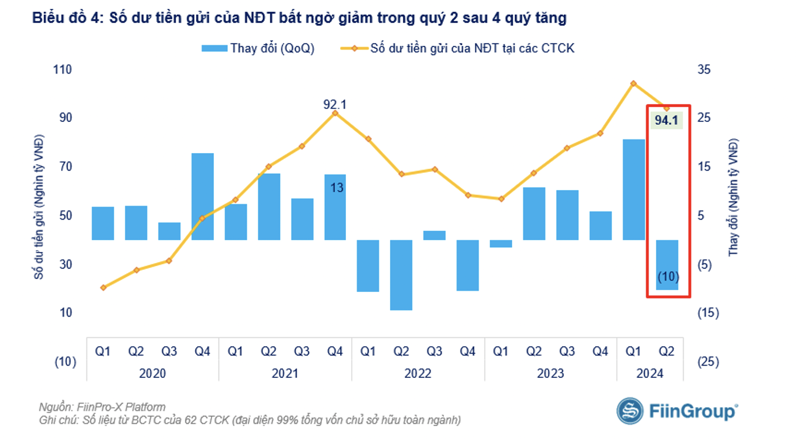
As of the end of Q2 2024, the deposit balance at securities companies reached VND 94,100 billion, down from approximately VND 100,000 billion at the end of Q1 2024. However, this figure remains higher than the previous record set in Q4 2021 of VND 92,100 billion.
According to FiinTrade's statistics from the Q2 2024 financial reports of 62 securities companies, representing 99% of the industry's equity capital, the deposit balance of securities investors decreased for the first time after four quarters of substantial growth from Q2 2023 to Q1 2024, despite the continued increase in the number of new individual investor accounts.
The deposit balance as of the end of Q2 2024 reached VND 94,100 billion, equivalent to nearly 4 billion USD, down from approximately VND 104,000 billion at the end of Q1 2024. Although it has decreased, this figure is still higher than the previous record of VND 92,100 billion set in Q4 2021.
In Q2 2024, individual investors net bought VND 39.6 trillion on HOSE, far exceeding the additional margin debt increase in the same quarter (VND 22.6 trillion). The net buying portfolio of individual investors mainly included leading industry stocks and/or large-cap stocks, which were under selling pressure from foreign investors, focusing on Vingroup (including VHM, VRE, VIC), Banking (STB, MSB, VCB, CTG, HDB, BID), Securities (VND, VCI, SSI), FPT, VNM, GAS, DGC.
The margin lending balance reached nearly VND 218.9 trillion as of June 30, 2024, an increase of 53.4% compared to the same period in 2023 and 11.5% compared to the end of Q1 2024. This is the highest margin lending balance in history.

Notably, the margin lending balance increased slightly or even decreased in securities companies with a large individual customer base (including VPS, VPBank, MBS…) while significantly increasing in companies serving institutional clients (including HCM).
The leverage ratio (Margin/Total market capitalization) unexpectedly rose to 9.4% at the end of Q2 2024 from 8.5% in the previous quarter. Specifically, the market capitalization (based on the free-float ratio) slightly decreased by VND 1.4 trillion, while the loan balance significantly increased by VND 22.6 trillion.
The margin debt/average transaction value ratio slightly increased to 10.4 times but remained low compared to the active liquidity phase (11-12.6 times), mainly due to liquidity improvement being insignificant and almost flat in Q2.
The margin debt/total equity ratio increased for the sixth consecutive quarter and reached 0.88 times as of June 30, 2024, significantly lower than the 1.2 times at the end of Q1 2022. This indicates that there is still considerable room for expanding margin lending if only the equity capital scale is considered.
However, meeting the margin debt/total equity ratio is only a necessary condition, while the sufficient condition for securities companies to expand margin lending is having sufficient funding sources. According to financial reports, the self-owned capital of securities companies is also allocated to other business segments, including proprietary trading (stocks, bonds, valuable papers…). Therefore, the actual room for funding to expand margin lending is not much.
Experts from FITD believe that while margin increases, it is not overly stressed, and the upward trend will continue in the future. The increase in margin mainly comes from the demand of business owners and banks, not from individual demand. However, this could pose risks to the market, such as creating a general market psychology about margin.
Nguyen The Minh, Head of Research and Analysis at Yuanta Securities, stated that the increase in equity capital allows investors to borrow more compared to 2021 when securities companies had not significantly increased their equity and charter capital. Currently, the market margin has not been fully utilized by all securities companies, so there is still plenty of room for additional lending.
"Particularly, the margin lending portfolio at securities companies is very healthy now. Previously, the most strained debt was primarily in real estate, which is a high-risk group, but now the debt in real estate companies is not much. No one dares to lend, and the margin portfolio of securities companies mainly focuses on production and banking sectors. Margin may even go higher, setting new records, but it remains healthy and there is no need to worry," Minh emphasized.