



: Era Town, Nguyen Luong Bang,Phu My Ward, District 7, Ho Chi Minh City
028 66843500
+886 956918888
hotline
028 66843500 +886 956918888

Vietnam's economy expands spectacularly

Post Date : Thursday, August 21, 2025

Nearly 40 Years of Reform: Vietnam’s Economic Achievements and Real Estate Potential

The Starting Point of Reform and Breakthroughs

Since 1986, when Vietnam shifted from a “centrally planned, bureaucratic subsidy economy” to a “socialist-oriented market economy,” the nation has endured countless challenges. At that time, national resources were exhausted after years of war, while facing border conflicts and long-standing embargoes. Despite these obstacles, the leadership made a historic decision to implement reforms, marking a turning point in the country’s development.

One of the most severe challenges was hyperinflation of 774% in 1986. It took Vietnam several years of monetary tightening and structural reforms to bring inflation down, eventually reducing it to single digits by 1993 and maintaining an average of about 5% from 1993–2000. Gradual liberalization of market mechanisms, improved financial policies, and a steadily evolving legal framework established the foundation for sustainable growth.

Economic Growth and Poverty Reduction Miracle

In 1990, Vietnam’s GDP per capita was less than USD 100, with around 70% of the population living in poverty. Even by 1993, the poverty rate stood at 58%. Through reforms, however, Vietnam achieved a remarkable poverty reduction: today, under the multidimensional poverty standard, the rate has fallen to below 1.9%.

According to the International Monetary Fund (IMF), Vietnam’s economy is projected to reach USD 491 billion in 2025, ranking 34th globally and 5th in Southeast Asia. By 2029, it could surpass USD 627 billion, overtaking Thailand to become the 32nd largest economy in the world.


Narrowing the Gap with Regional Peers

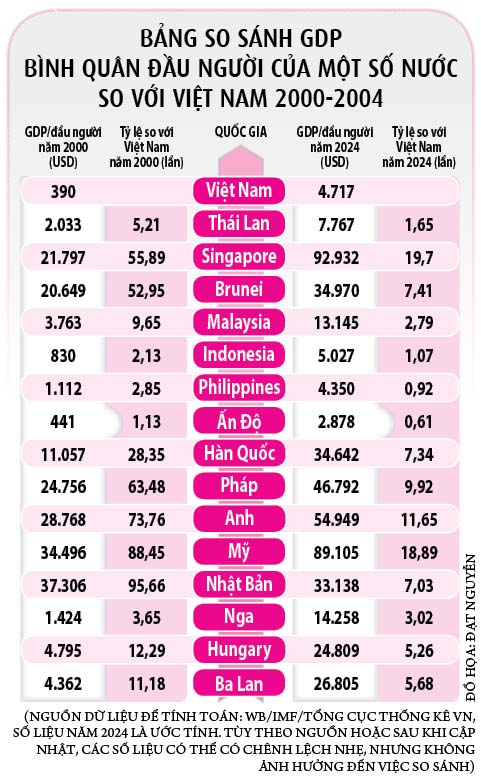
While Vietnam’s GDP per capita remains lower than that of Singapore and Malaysia, the gap has significantly narrowed. In 2000, Singapore’s GDP per capita was 55.8 times higher than Vietnam’s; by 2024, the difference had shrunk to 19.7 times. The Malaysia–Vietnam gap dropped from 9.6 times to 2.7 times, and Thailand’s from 5.2 times to 1.6 times. Vietnam is now nearly equal with Indonesia and has already surpassed both the Philippines and India.

These results demonstrate the effectiveness of the “socialist-oriented market economy model,” which has successfully combined political stability with rapid economic growth and social equity.

Infrastructure Growth and Real Estate Opportunities

As Vietnam’s economy strengthens, infrastructure development is accelerating. Expressways, bridges, metro systems, and international airports are being built at an unprecedented pace, enhancing the investment environment and fueling long-term growth in the real estate sector.

Key economic hubs such as Ho Chi Minh City and Hanoi, along with nearby provinces like Binh Duong, Dong Nai, and Can Tho, are becoming hotspots for both foreign and domestic investors. New urban areas, industrial parks, residential projects, and office towers are being developed to meet the demands of a rising economy.

Notably, according to World Bank classifications, Vietnam’s GNI per capita is expected to surpass USD 4,516 in 2025, officially elevating the country into the upper-middle-income group. Once this milestone is reached, both housing and investment demand will accelerate sharply.

Quy mô kinh tế Việt Nam có thể vượt qua Singapore vào năm 2029 - DNTT online

Outlook for the Future

Measured in Purchasing Power Parity (PPP), Vietnam has already reached high-income status. Moreover, with the gradual incorporation of the “shadow economy” (including cryptocurrency trading and entertainment activities) into official statistics and taxation, the actual size of Vietnam’s economy is even larger than reported.

Over the next 20 years, Vietnam’s strategic objective is to become a high-income developed country. This will not only drive industrial upgrading but also lead to a comprehensive transformation of its real estate market:

  • Residential Real Estate: Middle-class expansion will fuel stronger housing demand.

  • Commercial Real Estate: Increasing FDI inflows will drive demand for modern office space.

  • Industrial Real Estate: Supply chain shifts will make industrial parks highly attractive.

  • Tourism & Hospitality Real Estate: Long coastlines and international tourism growth will boost resort and leisure property markets.

Nearly 40 years of reform have proven Vietnam’s economic model to be both resilient and full of potential. With the “triple drivers” of rapid growth, infrastructure development, and accelerated urbanization, Vietnam’s real estate market presents enormous opportunities. For Taiwanese and international investors alike, this is a golden moment to enter and expand in Vietnam’s property market.


Thank you for rating
0 0

Free Consultation Update the latest information
Enter your information to receive our advice
capcha
capcha
News Update the latest information
Ho Chi Minh City Faces a Shortage of Affordable Rental Housing
Dong Nai is making a strong breakthrough, emerging as a new urban hub.
2026 社會住宅「大浪潮」:數萬戶新住宅同步啟動建設
When Infrastructure Meets Incentive Policies: Where Is the New Focus of Capital Flow?
Billion-Dollar Infrastructure Takes Shape, Positioning Dong Nai as a New Investment Hotspot!
Dong Nai Transforms Rapidly as Investors Rush to Capitalize on Infrastructure Growth Opportunities!
More Than $1 Billion Flows into the North of Ring Road 4 – Is a New Growth Hub Taking Shape?
Enhancing Land-Use Efficiency: Ho Chi Minh City Reclaims Project Land in the High-Tech Park
Infrastructure Breakthrough: Direct Connection Between Ho Chi Minh City and Vung Tau via the New Expressway
Vietnam Strengthens Its Position on the APAC Economic Map, Creating Major Opportunities for the Real Estate Market.
Video clip Update the latest information