



Post Date : Saturday, April 18, 2026
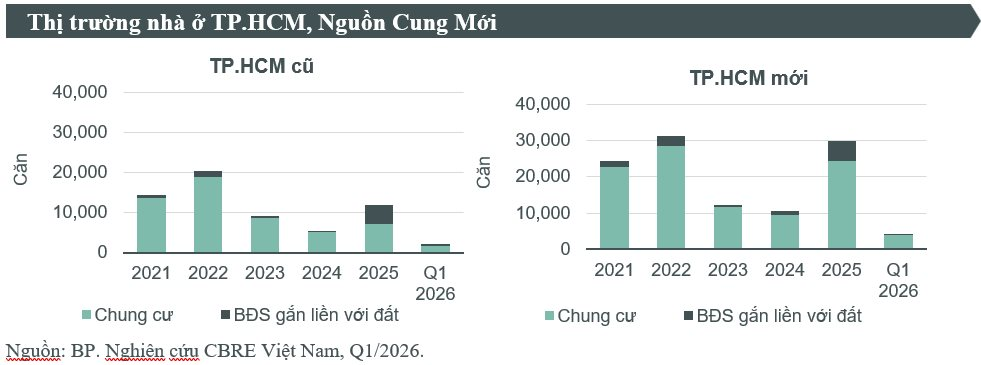
CBRE Việt Nam has just released a report on the real estate market in Ho Chi Minh City for Q1/2026. Accordingly, the market recorded a strong start to 2026, with a total of 3,840 condominium units and 231 landed houses launched for sale in Q1/2026, representing a 93% increase compared to the same period last year.
New supply in this quarter mainly came from the former Ho Chi Minh City area, accounting for nearly 40% of the total, indicating that this region remains the main investment hotspot. The remaining new supply largely came from surrounding areas, especially Binh Duong, which continues to play an important satellite role in the Ho Chi Minh City market.
Regarding the condominium sales market in the former Ho Chi Minh City area, the cumulative supply as of the end of Q1/2026 has exceeded 354,000 units. Notably, the inventory rate in this area accounts for only 2.6%. This further demonstrates the prolonged supply shortage in central and near-central districts of Ho Chi Minh City, maintaining strong market heat and high competitiveness for new projects.
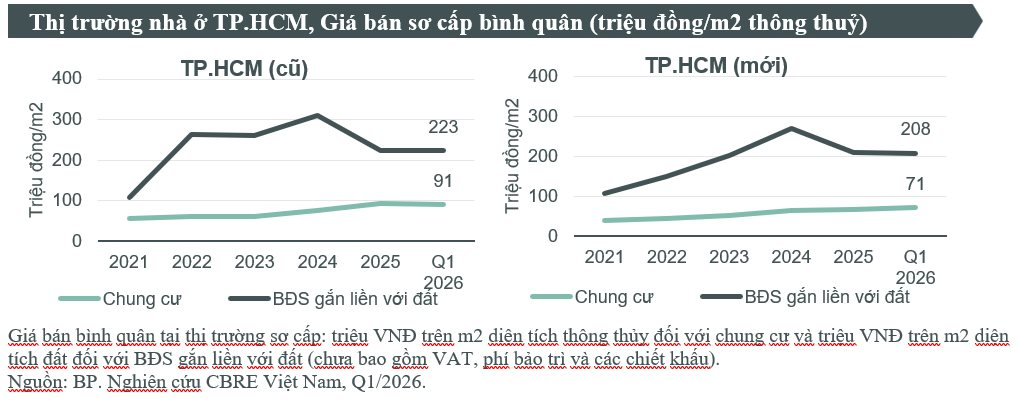
The average primary selling price of condominiums in Ho Chi Minh City (post-merger) has now reached 71 million VND/m² (based on net floor area, excluding VAT and maintenance fees), reflecting an 11% year-on-year increase and a 4.4% quarter-on-quarter rise. This indicates a market adjustment following a period of overheated growth (in early 2025, quarterly prices all recorded increases of over 17% year-on-year compared to 2024). Overall, prices are still on an upward trend, but the growth pace has slowed.
The average primary selling price of condominiums in Ho Chi Minh City (post-merger) has now reached 71 million VND/m².
The overall market absorption rate in Q1/2026 averaged 77% (compared to 73% for the full year of 2025).
For 2026, condominium supply in the former Ho Chi Minh City area is forecast to double compared to the previous year, with around 60% coming from the city’s eastern districts, where infrastructure and urban development are growing strongly.
On a citywide basis after the merger, total condominium supply is expected to reach nearly 34,000 units. Of this, the former Binh Duong area is expected to contribute more than 50% of the market share, reaffirming its key role in addressing future supply shortages in the overall market.
The structure of the condominium market in Ho Chi Minh City has also changed significantly following the administrative merger. The market has become more diversified, with over 42% of new launch supply in Q1/2026 priced below 60 million VND/m². This diversification not only meets broader buyer demand but also reflects the market’s efforts to provide suitable options for various customer segments.
For landed real estate in Ho Chi Minh City, supply is strongly driven by large-scale urban township projects in suburban areas, where land availability remains abundant and infrastructure development potential is being actively exploited.
Q4/2025 marked a historic milestone, as the low-rise housing market in the former Ho Chi Minh City area recorded a record supply of approximately 4,500 units launched for sale. This impressive figure brought the total annual supply to nearly 5,000 units, a 20-fold increase compared to 2024, marking the strongest growth ever recorded in this segment. This clearly signals a strong comeback from developers and a resurgence of market activity after a period of slowdown.
Entering Q1/2026, the market continued to demonstrate strong absorption of the abundant supply from Q4/2025. During this quarter, although only 87 new units were launched, more than 750 units were sold.
Supply is expected to continue improving significantly thanks to the rollout of multiple new urban township projects in the eastern and southern parts of the city—strategic areas with well-planned development and strong infrastructure investment. In 2026, new supply is projected to reach around 5,500 units and is expected to continue growing steadily in the following years, potentially exceeding 15,000 units by 2028.
Dương Thuỳ Dung – Executive Director of Research and Consulting at CBRE Việt Nam – stated: “Although the market is still maintaining relatively positive indicators, there remain many concerns regarding macroeconomic fluctuations, inflation, rising interest rates, and regional economic uncertainties. Unlike the previous ‘boom’ period, today’s buyers are saying no to excessive financial leverage and are maintaining a safe borrowing level below 40% to mitigate macro risks. This is a period of market filtering: buyers are becoming more selective, developers more cautious, and only truly high-quality products are strong enough to convince customers to make a purchase.”
Source: Phương Hoàng (Nhịp sống thị trường)