

Post Date : Wednesday, April 29, 2026
Vietnam's two largest cities are among the global leaders in growth potential over the next decade, reflecting their increasingly prominent role in the regional value chain.
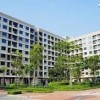
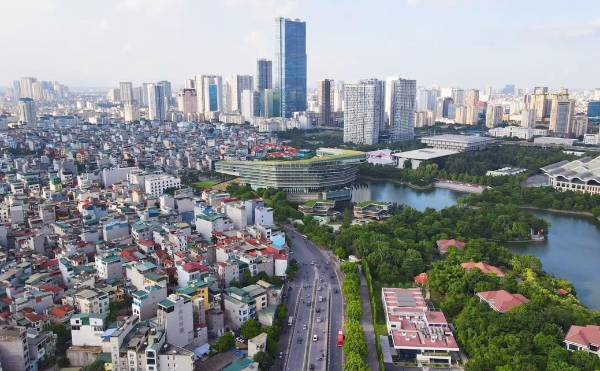
Illustrative image
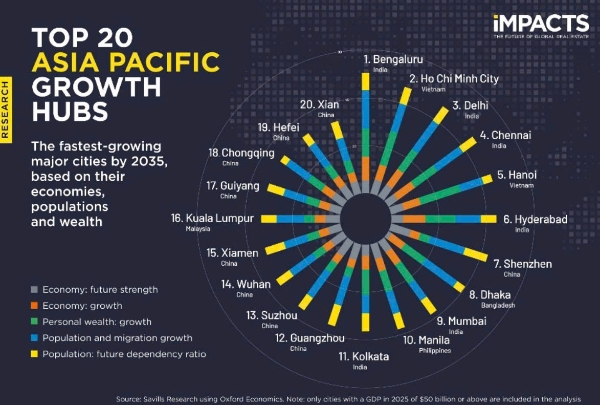
According to Savills’ analysis of 245 cities worldwide, growth over the next decade is expected to be heavily concentrated in Asia, driven by structural advantages such as a young population, rapid urbanization, and the global shift in manufacturing.
Notably, Vietnam stands out with strong performance, as Ho Chi Minh City ranks second globally and Hanoi ranks fifth in the Growth Hubs Index. The presence of both major cities among the global leaders not only reflects strong growth potential but also highlights Vietnam’s increasingly important role in the regional value chain.
Asia accelerates, Vietnam rises on structural advantages
Mr. Chris Marriott, Managing Director of Savills Southeast Asia, noted that the young demographic dividend is creating strong momentum for regional economies. A large labor force, rising consumption, and rapid urbanization are driving demand across multiple real estate segments, including industrial, logistics, residential, and mixed-use developments.

On the other hand, the “China+1” strategy continues to accelerate the shift of manufacturing to emerging markets, with Vietnam standing out as a key destination. Foreign direct investment (FDI) inflows are increasing, not only strengthening the manufacturing base but also creating spillover effects on the real estate market, particularly in Ho Chi Minh City and Hanoi, where infrastructure, labor, and consumer demand are concentrated.
However, according to Chris Marriott, Managing Director of Savills Southeast Asia, not all fast-growing cities can maintain long-term attractiveness. Studies on urban resilience show that leading cities such as New York, Tokyo, London, and Seoul share a common trait: the ability to balance economic growth with quality of life, while continuously investing to enhance competitiveness.
In this context, resilience is no longer a theoretical concept but has become a practical criterion for evaluating cities. It includes economic foundations, technology ecosystems, as well as Environmental, Social, and Governance (ESG) standards and living quality. More importantly, the ability to effectively and timely implement development strategies is becoming a key determining factor.
According to Neil MacGregor, Managing Director of Savills Vietnam, Vietnam has all the drivers to sustain high growth, from infrastructure and FDI inflows to domestic demand. However, the decisive factor lies in execution speed. Markets that can translate plans into reality faster will be those that capture opportunities.
In a context where “urban resilience” is becoming a core global benchmark, infrastructure is considered the fundamental factor that transforms growth potential into sustainable development capacity.
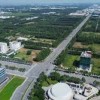
Neil MacGregor noted that large-scale public investment is gradually reshaping market structure. With around 234 infrastructure projects underway and a total estimated investment of about VND 3.4 quadrillion, key developments such as Long Thanh International Airport, metro systems in Hanoi and Ho Chi Minh City, and more than 380 km of newly operational North–South expressways are opening up new economic corridors.
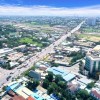
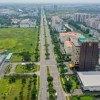
Infrastructure not only improves connectivity but also restructures urban space and investment flows. Satellite areas around Hanoi and Ho Chi Minh City are gradually forming new growth poles, while industrial real estate is directly benefiting from the development of integrated manufacturing and logistics ecosystems.
Notably, infrastructure impact goes beyond “hard infrastructure.” “Soft infrastructure” factors such as quality of life, environment, education, and healthcare increasingly influence decisions of businesses and high-quality labor. These are core components of a city’s long-term competitiveness.
According to Neil MacGregor, as global growth centers continue shifting toward Asia, Vietnam aims for double-digit growth driven by two main pillars: infrastructure investment and FDI inflows. However, the decisive factor is not only investment scale, but execution capability—from project timelines and legal frameworks to the financial environment. This will directly affect the speed at which new growth poles emerge and the future expansion of urban space and real estate supply.
In the long term, with a stable economic foundation, sustained FDI inflows, and rapid urbanization, Vietnam’s market outlook remains positive. However, experts emphasize that the question is no longer whether Vietnam will grow, but how quickly and effectively it can realize these growth drivers.
Source: Thanh Xuân