


Post Date : Monday, April 01, 2024
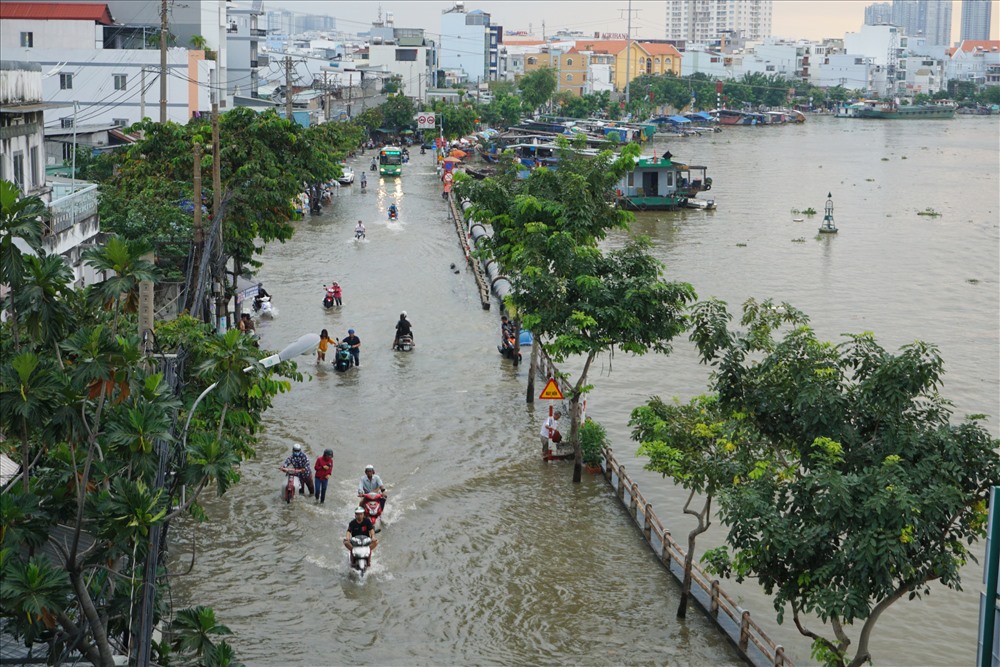
From April 1st to 10th, Ho Chi Minh City will experience a significant incursion of saltwater intrusion into its rivers, canals, and streams, severely impacting the daily life and production activities of its residents.
Recently, many provinces in the Southern region, including Ho Chi Minh City, have been affected by salinity intrusion and heatwaves. According to the Southern Regional Hydrometeorological Center, the saltwater intrusion phenomenon of 2024 began early, with signs appearing in mid-November. It penetrated deeply into the inland areas, with salinity levels of 4 g/l reaching 40-50 km inland and, in some places like Tien Giang, up to 70 km.
This situation has been particularly severe in provinces like Ben Tre, Soc Trang, Long An, and Tra Vinh, where the salinity levels have been higher than the average of many years, nearly matching the figures from 2016 and 2020.
During the mentioned period, the water levels on the Mekong River will see little change initially, followed by a slow rise. The water flow at the Kratie station is approximately 21% lower than the same period in 2023 but 7.4% above the multi-year average.

In the downstream areas of the Western rivers, tides rise quickly and then fall rapidly. The salinity front of 4g/l is about 55-60km from the Tien River mouth and 40-45km from the Hau River mouth.
In Ho Chi Minh City, the highest water levels recorded at various stations along rivers, canals, and streams in the area are rising slowly, by about 5-10cm, before receding. The salinity levels are higher than those of the previous year and the multi-year average, with the 4‰ salinity front reaching as far as 76-78km along the Saigon River.
In the upcoming week, water levels at most stations in Ho Chi Minh City are expected to decrease rapidly in the first half of the week before rising again towards the weekend. The highest tides of the week are forecasted to occur towards the weekend, with salinity levels reaching their peak at most stations towards the weekend. Specifically, the Long Dai station will see its peak salinity early in the week, higher than the figures from the same period in 2023 and the multi-year average. Along the Saigon River, the 4‰ salinity front is expected to penetrate as far as 75-80km.
The Southern Regional Hydrometeorological Center has assessed this as a significant saltwater intrusion event into the rivers, canals, and streams of Ho Chi Minh City, leading to a critical shortage of fresh water. This situation poses severe implications for the livelihoods and productive activities of the population.
In response to the saltwater intrusion in Ho Chi Minh City, Mr. Nguyen Duc Vu, Head of the Irrigation Department at the Department of Agriculture and Rural Development of Ho Chi Minh City, mentioned that multiple measures have been implemented, such as regular monitoring and forecasting of salinity levels in rivers, canals, and streams, as well as updating information periodically on the website of the Civil Defense Command - Disaster Prevention and Search and Rescue of the City. There is also a push for the inspection and operation of irrigation structures and water intake sluices to ensure they function effectively, providing sufficient water for agricultural production, aquaculture, forestry, crop cultivation, and livestock.

Long-term solutions to counteract saltwater intrusion include increasing investment in building more automatic water source monitoring stations (SCADA) to have a complete set of data for early warning and forecasting of salinity intrusion.
Additionally, early forecasting programs for salinity intrusion trends will be developed to provide early warnings and enable proactive response measures. Dredging of main and primary canals will also be undertaken to enhance water conveyance and storage capabilities during the dry season and facilitate drainage in case of environmental pollution incidents.
Regarding the early onset of hot weather in the Southern region, the Southern Regional Hydrometeorological Center notes that typically, from mid-February each year, the Southern region begins to experience hot weather in some areas of the Southeastern provinces. However, this year saw an earlier appearance of hot weather across the Southern provinces.
Similar to the strong El Niño years of 2015-2016 and 2019-2020, the 2023-2024 season has experienced an earlier onset of hot weather compared to the multi-year average. In January, several days of hot weather were recorded in some Eastern Southern provinces, with temperatures increasing in early February. Since February 9th, there has been a continuous occurrence of hot weather, with Bien Hoa recording a maximum daytime temperature of 38°C on February 15th, a notably high figure for February.
Although the end of February saw some cloud cover and occasional rain in a few places, the rainfall, being under 10mm, only provided temporary relief from the heat, which continued thereafter.
For more information about real estate projects in Ho Chi Minh City and neighboring provinces, please contact FTT LAND!
------------------------------------------
FTT REAL ESTATE COMPANY
Headquarters in Vietnam: EA4-01.01 Eratown Duc Khai, Nguyen Luong Bang, Phu My Ward, District 7
Receive consignments for buying, selling and renting apartments, updating the best prices in the market
HOTILINE: +(84) 81.299.1003
┃For inquiries: 黎娟娟/Winnie - FTT Land Real Estate
┃Vietnam Hotline: (+84) 902.823.622 (viber/zalo/Whatsapp)
┃Taiwan Hotline: (+886) 906.975.509
┃ID (Line/IG/Tiktok): winniele88888
┃Wechat ID :Winniele88888888
┃Watch more on YOUTUBE: FTT REAL ESTATE
┃Website: www.fttland.com