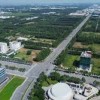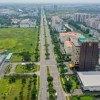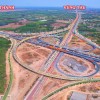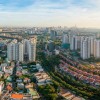





Hoa Phat Steel factory at Thuan Dao Industrial Park. Photo: Dongtam Group
Not only Tay Ninh, industrial parks across Southern Vietnam have recently been actively attracting high-quality investment inflows. In the first quarter, industrial parks and economic zones in Dong Nai attracted 65 new projects, with increased capital from both domestic and foreign direct investment (FDI), totaling USD 803 million. Notable investors with advanced technology and high governance standards include Jabil Circuit and Sembcorp Integrated Hub (Singapore).
Notably, Ho Chi Minh City attracted nearly USD 2.9 billion in FDI in Q1, up more than 200% year-on-year, focusing on high-tech, finance, advanced manufacturing, and digital infrastructure sectors, according to the city’s People’s Committee. Real estate services firm Avison Young highlighted the increasingly clear shift toward high-tech and digital infrastructure in this economic hub, with projects such as data centers by CMC and Sembcorp.
The increase in both the quantity and quality of capital signals a new phase of development for Southern Vietnam’s industrial real estate market. Cushman & Wakefield Vietnam noted that this segment is entering a more “strategic” stage.
Specifically, after a decade of growth driven mainly by scale expansion, the region is now transitioning toward a “quality-focused” development phase, according to Ms. Truong Quoc Doan, Deputy Director of Leasing Advisory – Industrial & Office at Cushman & Wakefield Vietnam. At this stage, infrastructure connectivity, product quality, operational efficiency, and sustainability become key drivers, aligning with increasingly sophisticated customer expectations.
“Demand is increasingly shifting toward better-planned industrial assets, more modern ready-built facilities, and locations that can support both production efficiency and supply chain resilience,” she noted.
In fact, during the first three months of the year, leasing demand in Ho Chi Minh City mainly came from export-oriented manufacturing and high-tech enterprises, with increasingly clear ESG requirements, according to Avison Young. The firm also pointed out that the market is further supported by the city’s push in infrastructure development, with key projects such as Can Gio Bridge, Phu My 2 Bridge, Cat Lai Bridge, and the Hiep Phuoc LNG power plant in Q1.
On the occasion of April 30, the city is set to commence construction on two large-scale seaport projects: the Can Gio International Transshipment Port and the Cai Mep Ha General and Container Port (Phase 1), aiming to develop into regional and international logistics hubs.
According to Mr. Pham Binh An, Deputy Director of the Ho Chi Minh City Institute for Development Studies, the city is expanding toward a multi-centered mega-urban model, in which industrial, logistics, and service hubs are interconnected to form a complete value chain.

Industrial real estate market in Ho Chi Minh City, Tay Ninh, and Dong Nai. Chart: Cushman & Wakefield
Tay Ninh is also capitalizing on this trend by upgrading the quality of its industrial real estate supply. Mr. Truong Thanh Liem, Head of the Tay Ninh Economic Zone Authority, stated that the province has planned 100 industrial parks with a total area of up to 31,000 hectares. Currently, 51 parks have been established, covering 15,337 hectares, of which 34 are ready to receive investment, totaling more than 10,000 hectares.
“The province is continuing to expand its planning, linking industrial parks with transport infrastructure, logistics, and industrial urban development, aiming to create modern, eco-friendly, and smart industrial zones that meet the high standards of international investors,” Mr. Liem said.
Overall, Ho Chi Minh City, Tay Ninh, and Dong Nai currently have a total industrial land supply of 36,400 hectares across 161 projects. The region also has approximately 6.60 million square meters of ready-built factories and 6.65 million square meters of ready-built warehouses, according to Cushman & Wakefield.
By 2036, the firm forecasts that supply will increase to at least 58,557 hectares across around 250 projects, with ready-built factories and warehouses reaching 7.76 million square meters and 7.31 million square meters, respectively. This will further strengthen the region’s role as one of Vietnam’s key corridors for manufacturing, logistics, and industrial investment.
Source: Anh Ky