


Post Date : Wednesday, April 22, 2026
According to data from the Ho Chi Minh City Department of Planning and Architecture, the city’s total demand for social housing by 2030 is estimated at around 974,000 units, with 70% coming from low-income groups and industrial workers. Meanwhile, the city has identified 193 projects with a scale of approximately 229,187 apartments on more than 740 hectares of land. Thus, the projected supply currently meets less than one quarter of the demand.
The department also stated that Ho Chi Minh City has allocated about 1,400 hectares for social housing development. After expanding administrative boundaries and adding nearby areas, the total land fund is estimated at around 1,700 hectares, and may even be increased to nearly 2,000 hectares in the future. This is considered an important foundation for implementing the social housing development plan for the 2021–2030 period. Although it is unlikely to fully meet actual market demand, the new supply is expected to partly ease the housing shortage for low-income groups in the city.
Despite having a list of projects in place, actual implementation progress remains slower than expected. The biggest bottleneck identified by businesses and experts is the prolonged legal procedures, which make it difficult for supply to accelerate.
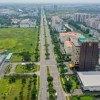
Real estate in the Eastern area of Ho Chi Minh City with apartment projects. Photo: Quỳnh Trần
At a recent seminar titled “Removing bottlenecks to unlock social housing supply” organized by Tuổi Trẻ Newspaper, Mr. Bùi Hữu Nghĩa, CEO of Lê Thành Company, said that in theory, the legal process for a social housing project has been shortened to around 132 days. However, this only applies when the dossier is fully complete. In reality, developers must prepare and revise documents multiple times, making the total timeline two to three times longer.
According to him, a social housing project must go through many stages such as land fund establishment, investment policy approval, planning adjustment, land use purpose conversion, appraisal, and construction permits. Each step requires consultation with multiple government departments, while some procedures overlap or are merely formal, further prolonging processing time.
In addition to administrative procedures, planning regulations are also a bottleneck, as many suitable land plots cannot be developed due to not meeting population density or land-use function requirements, forcing adjustments that delay progress.
Mr. Nghĩa estimated that a social housing project typically takes 18–24 months to complete legal procedures, plus about two years of construction. Therefore, if starting now, the earliest handover would be in 2028–2029. “This shows that today’s supply is the result of decisions made 2–3 years ago. If bottlenecks are not resolved in time, the shortage will continue,” he said.
Mr. Lê Hoàng Châu, Chairman of the Ho Chi Minh City Real Estate Association, further analyzed that the biggest bottleneck currently lies in implementation, as the legal system remains overlapping and inconsistent. Many projects have available land but cannot proceed due to planning issues and land-use conversion procedures.
Specifically, administrative procedures have not been sufficiently reformed. Social housing projects still require construction permits even when detailed planning already exists, while some commercial housing projects benefit from simplified procedures.
Regarding funding, he noted that this is a key factor but has not been effectively resolved. Preferential credit sources are unstable, and developers struggle to access long-term capital.
“The procedures are overlapping, each agency interprets differently, and in many cases, the law allows it but there are no guiding decrees, making implementation very difficult,” Mr. Châu said.
This reality is directly affecting social housing supply in Ho Chi Minh City. According to a report by the city’s Labor Federation, during 2021–2025, only about 19,000 units have been completed, while the target by 2030 is 200,000 units. In 2026 alone, the target is about 28,500 units, but by the end of the first quarter, only 580 units were completed, reaching just around 2% of the plan.
Although the city plans to launch dozens of projects in the coming period to improve supply, progress still heavily depends on the ability to remove procedural barriers and mobilize funding. In particular, the expanded income eligibility criteria have significantly increased the number of people qualified to buy social housing, further intensifying pressure on already limited supply.
In response, Mr. Nguyễn Văn Hoan, Deputy Head of Urban Development at the Ho Chi Minh City Department of Construction, said the city is implementing several measures to accelerate progress. The department has advised the city to cut at least 50% of administrative procedures, hold monthly meetings, and establish task forces to resolve investment and construction issues.
However, experts believe stronger reforms are needed, such as eliminating unnecessary procedures, allowing parallel processing of multiple steps, and introducing more flexible financial and planning mechanisms. Given the huge demand, removing bottlenecks in procedures and funding is considered key to accelerating social housing supply. If not improved, the gap between supply and demand in Ho Chi Minh City is expected to continue widening in the coming years.
Phương Uyên