



Post Date : Monday, July 29, 2024
Taiwanese Enterprises Continuously Investing in Vietnam, Increasing Demand for Factories
An increasing number of Taiwanese manufacturers are establishing a solid presence in Vietnam with the goal of diversifying their supply chains. This trend includes major electronics groups such as Foxconn, Pegatron, Compal, and Wistron.

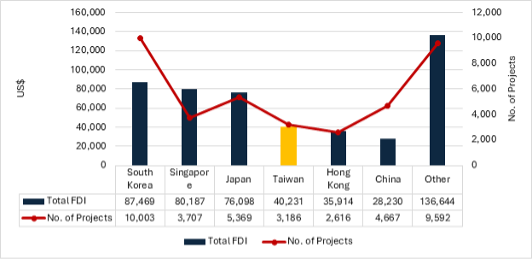
As of June 2023, Taiwan ranks fourth in foreign direct investment (FDI) in Vietnam, with 3,186 projects and a total value of USD 40.23 billion, accounting for 8% of the total FDI in Vietnam since 1988.
Vietnam aims to become a semiconductor production hub, while Taiwan is renowned for its successful semiconductor industry. Taiwanese investors bring valuable expertise that can help Vietnam achieve this goal.
According to John Campbell, Deputy Director of Industrial Real Estate Services at Savills Vietnam, in the first half of 2024, Taiwan registered 39 new manufacturing projects in Vietnam with a total value of USD 513.37 million, accounting for 49% of Taiwan's total FDI during this period. Of these, 22 projects are in the North and 17 projects are in the South. Although the North attracted more new manufacturing projects, the South recorded the majority of investment value, reaching USD 285.4 million, mainly due to Tripod Technology’s substantial investment of USD 250 million in the Chau Duc Industrial Park in Ba Ria-Vung Tau.
The Northern region is expected to continue attracting Taiwanese investments in electronics and semiconductors, while the Southern region may receive more projects with medium added value. Among the 39 new Taiwanese manufacturing projects in the first half of 2024, there were 24 industrial land transactions and 15 factory projects. Industrial land projects dominated in terms of revenue, accounting for 92% of the investment, reflecting the growing demand for factories from various Taiwanese manufacturers.
These companies typically do not require large land areas and prefer short-term leases, creating opportunities for factory and warehouse developers in Vietnam. For example, BW Industrial Development, Vietnam's largest industrial real estate developer, currently has 18 Taiwanese tenants, including Jusda, Sable Speaker Solutions, FSP Group, and Alltop.
Ba Ria-Vung Tau leads in investment value, with USD 264.1 million, thanks to Tripod Technology. Thanh Hoa ranks second with 23%, and Ha Nam ranks third with 8%, having the highest number of six new Taiwanese manufacturing projects.

The electronics industry leads in investment value, with four projects totaling USD 255 million, accounting for 50%. The garment industry ranks second with five projects, followed by electrical equipment with seven projects. Wistron is the second-largest Taiwanese electronics manufacturing investment in the first half of 2024, with USD 24.5 million.
Post-pandemic, Taiwanese FDI in Southeast Asia increased significantly from 2022 to 2023, showing supply chain diversification. Taiwan’s new manufacturing FDI registered in 2023 amounted to USD 1.87 billion, nearly 8.7 times the figure for 2022. John noted that this increase aligns with Taiwan's New Southbound Policy (NSP), enhancing cooperation with Southeast Asian countries and benefiting Vietnam's high-tech electronics industry.
Taiwanese investors favor Vietnam's young and increasingly skilled workforce, stable business environment, competitive labor and construction costs, favorable geographic location, and active participation in numerous free trade agreements (FTAs). Thạch Thụy Kỳ, Chief Representative of the Taipei Economic and Cultural Office in Vietnam, stated at the "2024 Vietnam-Taiwan (China) Business Forum" that Vietnam and the Philippines are top destinations for traditional industry investments, while Vietnam is the first choice for high-tech electronics, followed by Indonesia, India, and the Philippines.
However, CY Huang, founding president of the Southeast Asia Influence Alliance, pointed out that Taiwanese businesses hope Vietnam will address electricity shortages, establish mechanisms to mitigate the impact of global minimum taxes, and actively train high-quality human resources, especially in the electronics and semiconductor industries.