



: Era Town, Nguyen Luong Bang,Phu My Ward, District 7, Ho Chi Minh City
028 66843500
+886 956918888
hotline
028 66843500 +886 956918888

The Rise and Development of NVIDIA

Post Date : Thursday, June 13, 2024

NVIDIA, once an obscure graphics processing chip company, has grown into the sixth-largest company in the world with a market capitalization reaching trillions of dollars, becoming a leader in the era of Artificial Intelligence (AI). This article will delve into NVIDIA's development journey and its dominant position in the AI hardware market.

In 1963, Jensen Huang was born in Tainan, Taiwan, and moved to the United States at the age of nine. After graduating from college, he worked at two semiconductor companies, accumulating rich experience in chip design. In 1993, he co-founded NVIDIA with two like-minded partners, focusing on graphics processing chips. Despite initial failures with products NV1 and NV2, NVIDIA successfully entered the market in 1997 with the Riva128 graphics card.

In 1999, NVIDIA released the groundbreaking GeForce256 graphics card, pioneering the concept of the GPU (Graphics Processing Unit), laying the foundation for its leadership in the graphics processing market. Through strategic partnerships with Microsoft and TSMC, NVIDIA rapidly expanded its market share, reaching 80% in the standalone graphics card market by 2022.

The design of GPUs gives them a significant advantage in parallel computing over CPUs, making them indispensable in AI training. In 2006, NVIDIA introduced the CUDA programming model, allowing GPUs to perform general-purpose computing, thus expanding their application fields to include aerospace, biopharmaceuticals, weather forecasting, and more.

GPUs (Graphics Processing Units) were originally designed to efficiently handle graphical data, giving them a natural advantage in parallel computing. Unlike traditional Central Processing Units (CPUs), GPUs have hundreds or even thousands of small processing cores capable of handling multiple simple tasks simultaneously. Thus, GPUs are particularly well-suited for workloads that require extensive parallel computations, such as image processing and machine learning.

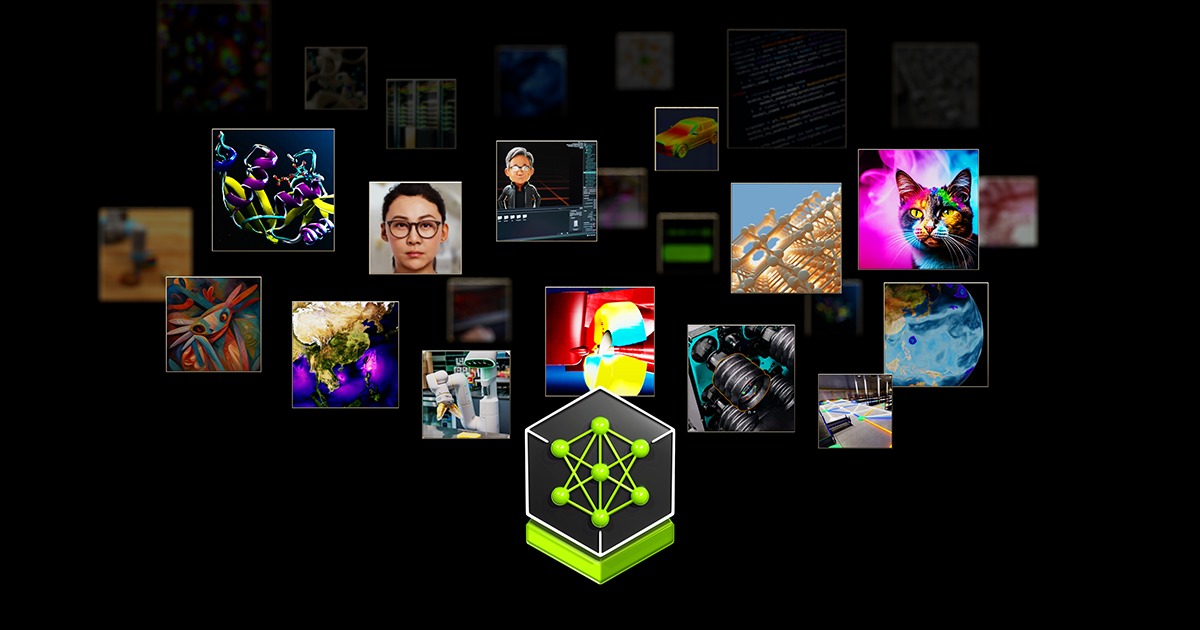
NVIDIA NIM for Deploying Generative AI | NVIDIA

In AI training, models need to process vast amounts of data, often involving numerous matrix operations and floating-point calculations. The parallel computing architecture of GPUs allows them to handle thousands of computational tasks simultaneously, significantly speeding up data processing. For example, training a large neural network model typically requires extensive repetitive computations on large datasets, a task well-suited for GPUs due to their ability to perform many calculations concurrently.
In 2006, NVIDIA introduced the CUDA (Compute Unified Device Architecture) programming model, a revolutionary technology enabling GPUs to perform general-purpose computing. Through CUDA, developers can use the C programming language to write code that allows GPUs to execute non-graphical computing tasks. The introduction of CUDA not only expanded the application range of GPUs but also enabled many scientific computations, engineering simulations, and data analysis tasks to run efficiently on GPUs.

Since the launch of CUDA, the application fields of GPUs have continuously expanded, covering high-performance computing areas such as aerospace, biopharmaceuticals, and weather forecasting. For example, in aerospace, GPUs are used to simulate the aerodynamic performance of aircraft; in biopharmaceuticals, GPUs help scientists conduct complex molecular simulations and drug development; in weather forecasting, GPUs process and analyze vast amounts of meteorological data, improving forecast accuracy and speed.

In AI training, GPUs have a clear advantage over CPUs. According to NVIDIA data, using GPUs to train large language models costs only a quarter of what it would with CPUs and consumes just one-fifth of the power. This significant performance and cost advantage has led nearly all top AI companies to choose NVIDIA's GPUs for model training, including tech giants like Google, Amazon, Microsoft, and Baidu.

The explosive growth of cryptocurrencies like Bitcoin has driven massive demand for high-performance graphics cards, particularly NVIDIA's GPUs, due to their powerful parallel computing capabilities that are well-suited for cryptocurrency "mining". Mining essentially involves performing a large number of complex calculations to verify blockchain transactions and generate new cryptocurrencies.

From 2018 to 2021, the popularity of cryptocurrencies led to a surge in global demand for NVIDIA graphics cards. Many miners purchased high-performance GPUs from NVIDIA to build mining rigs, enabling faster cryptocurrency mining. Market analysis indicates that during this period, NVIDIA's revenue from mining-related demand reached 1 to 3 billion USD annually. The high demand for graphics cards during this period also elevated NVIDIA's market position and brand influence.

To meet market demand, NVIDIA even developed GPUs specifically for cryptocurrency mining, such as the CMP (Cryptocurrency Mining Processor) series. These specialized mining GPUs removed display output interfaces and optimized mining performance, making cryptocurrency mining more efficient.

Despite the substantial revenue from the cryptocurrency boom, it has never been NVIDIA's primary business. With the volatility of the cryptocurrency market and increased regulation, the impact of mining on NVIDIA's revenue has been unstable. For instance, during the cryptocurrency market crash, NVIDIA's stock price once plummeted by 46%. Consequently, NVIDIA has always focused on AI as its core strategy for future development.

Propelled by the cryptocurrency boom, NVIDIA's graphics card technology and market coverage have rapidly improved. However, the company understands that the cryptocurrency market is highly volatile and cannot be a stable long-term revenue source. Therefore, NVIDIA has always prioritized AI as its core strategy for future growth. By continuously enhancing the application performance of GPUs in AI training and computation, NVIDIA has not only solidified its leadership in the AI hardware market but also laid a strong foundation for future technological innovation.

In conclusion, through continuous innovation and strategic adjustments, NVIDIA has achieved remarkable success in multiple fields, from graphics processing and cryptocurrency to artificial intelligence. As technology evolves and the AI era unfolds, NVIDIA is poised to continue leading at the forefront of technological innovation.


Thank you for rating
0 0

Free Consultation Update the latest information
Enter your information to receive our advice
capcha
capcha
News Update the latest information
Ho Chi Minh City Faces a Shortage of Affordable Rental Housing
Dong Nai is making a strong breakthrough, emerging as a new urban hub.
2026 社會住宅「大浪潮」:數萬戶新住宅同步啟動建設
When Infrastructure Meets Incentive Policies: Where Is the New Focus of Capital Flow?
Billion-Dollar Infrastructure Takes Shape, Positioning Dong Nai as a New Investment Hotspot!
Dong Nai Transforms Rapidly as Investors Rush to Capitalize on Infrastructure Growth Opportunities!
More Than $1 Billion Flows into the North of Ring Road 4 – Is a New Growth Hub Taking Shape?
Enhancing Land-Use Efficiency: Ho Chi Minh City Reclaims Project Land in the High-Tech Park
Infrastructure Breakthrough: Direct Connection Between Ho Chi Minh City and Vung Tau via the New Expressway
Vietnam Strengthens Its Position on the APAC Economic Map, Creating Major Opportunities for the Real Estate Market.
Video clip Update the latest information